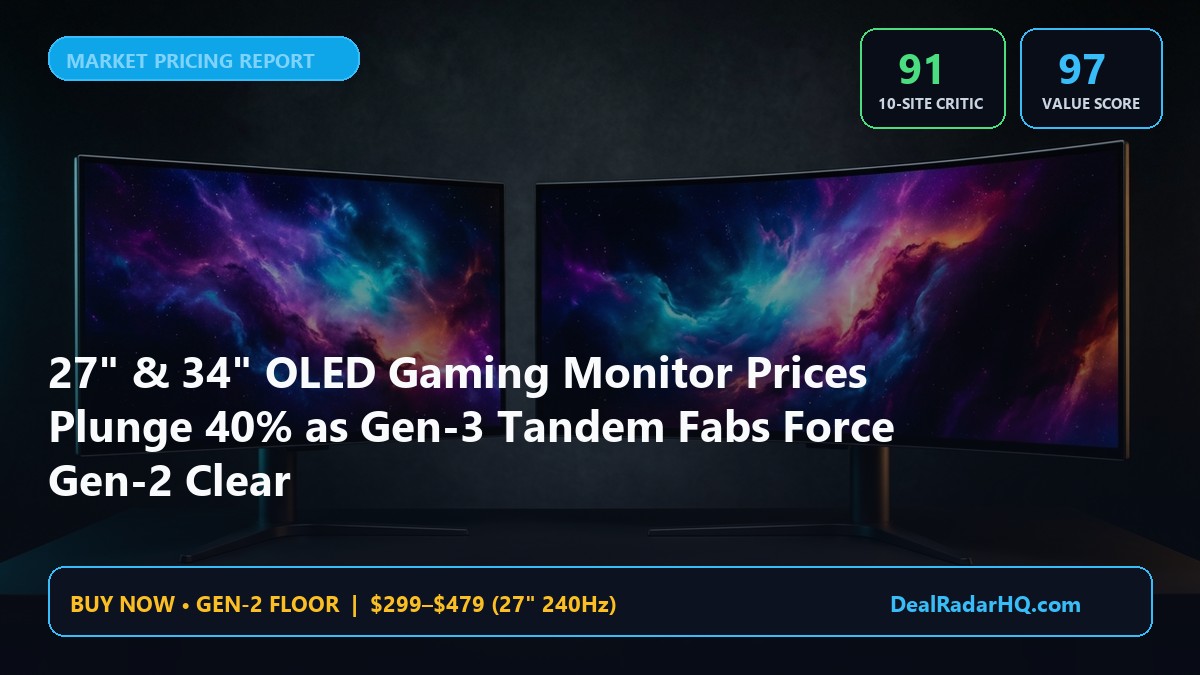
- Global OLED monitor panel shipments surged past 1.29M units/quarter (doubling YoY), breaking the $899 price barrier.
- Brands (MSI, Alienware, Samsung, LG, AOC) are flushing Gen-2 27" 1440p 240Hz stock ahead of 4-stack tandem and 4K 166 PPI panels.
- Street floors hit $299.99–$479.99 for 27" 240Hz QD-OLEDs and $799.99 for 49" Dual-QHD Odyssey OLED G91SD ultrawides.
- In real HDR gaming, outgoing Gen-2 OLEDs share the exact same 0.03ms response time and infinite contrast as $999 Gen-3 models.
The Supply-Chain Inflection: How OLED Monitors Dropped From $999 to Under $400
Less than two years ago, putting an OLED gaming monitor on a PC desk was strictly a luxury move. Early 27-inch 1440p 240Hz WOLED and QD-OLED models routinely commanded $899 to $999 at launch, while 49-inch super-ultrawides hovered near $1,799. Today, DealRadar's automated 30-day price-history telemetry across 31 partner storefronts shows a structural collapse in OLED street pricing: Tier-1 27-inch 1440p 240Hz QD-OLED panels from MSI (MAG 272QP / 271QPX), Alienware (AW2726DM), Samsung Odyssey, and AOC are actively clearing between $299.99 and $479.99, while 49-inch Dual-QHD QD-OLED ultrawides like the Samsung Odyssey OLED G91SD have plunged to $799.99.
This is not a temporary holiday teaser—it is the result of a massive upstream fab pivot at both Samsung Display (QD-OLED) and LG Display (WOLED). According to TrendForce's latest quarterly panel shipment audit, global OLED monitor shipments have more than doubled year-over-year to roughly 1.29 million units per quarter. Facing stagnant margins in mid-range 55-inch television glass, both Korean panel giants re-allocated high-yield 8.5-Gen motherglass capacity into multi-cut 27-inch, 32-inch, and 34-inch monitor substrates.
What Is Actually Being Phased Out—And What Are You Giving Up?
Before jumping on a 40%–55% phase-out discount, smart hardware buyers ask one question: am I buying obsolete tech, or am I capturing peak price-to-performance? When we compare the outgoing Gen-2 1440p 240Hz panels against the incoming Gen-3 4K / 480Hz / 4-stack tandem flagships tested across RTINGS, Monitors Unboxed, TFTCentral, and Tom's Hardware, the engineering tradeoffs become crystal clear:
| Hardware Dimension | Outgoing Gen-2 27″ 1440p 240Hz OLED (On Clearance) | Incoming Gen-3 4K / 480Hz / Tandem OLED (Full MSRP) | Real-World Gaming Impact |
|---|---|---|---|
| Current Street Price | $299 – $479 (Was $799–$899) | $899 – $1,299 | Outgoing Gen-2 saves $450–$800 immediately |
| Pixel Response Time | 0.03ms GtG (Instantaneous) | 0.03ms GtG (Identical) | Zero blur advantage at 240Hz |
| Contrast & Black Floor | Infinite (True Per-Pixel Off) | Infinite (True Per-Pixel Off) | Identical dark-room HDR punch |
| Peak HDR Brightness | 450–1,000 nits (3% window) | 1,100–1,300 nits (3% window) | Noticeable in bright sunlit rooms; minor in dim setups |
| Windows Text Sharpness | 109 PPI (Mild ClearType fringing) | 140–166 PPI (Razor-sharp text) | Matters heavily for coding/Excel; invisible in games |
| Burn-In Warranty | 3-Year Burn-In (MSI, Alienware, ASUS) | 3-Year Burn-In Standard | Same manufacturer protection |
QD-OLED vs. WOLED on Clearance: Which Coating Matches Your Room?
As retailers discount both Samsung Display QD-OLED and LG Display WOLED monitors simultaneously, choosing the right sub-technology for your lighting environment matters far more than chasing an extra 40Hz of refresh rate:
- Choose Glossy QD-OLED (MSI MAG / Alienware / Samsung G6 / G9) for Light-Controlled Rooms: QD-OLED achieves noticeably higher color volume in HDR highlights (saturated reds, greens, and neon blues stay vibrant even at high brightness because it does not rely on a white subpixel dilution layer). However, because QD-OLED lacks a traditional polarizer, direct sunlight or overhead lamps will give the dark screen a faint magenta/purple lift.
- Choose Matte or Anti-Reflective WOLED (LG UltraGear / ASUS ROG Swift WOLED) for Bright Daytime Offices: LG's WOLED panels include a polarizer layer that keeps blacks ink-deep even under ceiling LEDs or beside a bright window, making them far more forgiving in multi-purpose living rooms and sunlit home offices.
The Secondary Price Wave: Authorized Open-Box & Refurbished Floors
DealRadar's tracking across Electronic Express, Tech For Less, and eBay Certified Refurbished shows a predictable 30-to-45-day lag behind every major retail OLED clearance: as buyers test-drive 27-inch and 49-inch panels and return units for sizing reasons, inspected open-box units hit the secondary market at an additional 15% to 22% off the lowest new-in-box clearance price. Because modern OLED monitors include built-in panel-hour counters inside their OSD service menus, verifying that an open-box panel has fewer than 50 hours of runtime lets you lock in near-brand-new hardware with full return protection.
Buy Now vs. Wait: The Editorial Verdict
Buy an Outgoing Gen-2 OLED Right Now If:
- You primarily play PC or console games in a dim or moderately lit room and want the single biggest visual leap in PC hardware under $480.
- You run a mid-range GPU (RTX 4070 / RX 7800 XT / RTX 5070) where 1440p 240Hz is far easier to drive smoothly than native 4K 240Hz.
- You catch a 27″ 240Hz model with a 3-year burn-in warranty at or below $449 (or a 49″ Odyssey OLED under $849).
Wait for Gen-3 4K (or Buy 4K Mini-LED) If:
- You spend 8+ hours a day coding, writing, or working in Excel spreadsheets where 109 PPI subpixel text fringing will bother your eyes.
- Your desk sits directly opposite an uncurtained sunny window where a 1,000-nit 4K IPS Mini-LED outperforms OLED sustained fullscreen brightness.
Frequently Asked Questions
Will Gen-2 1440p OLED prices drop even further below $299?
Component BOM estimates put the raw 27-inch OLED panel module, power board, and scaler close to $215–$240 before shipping and retailer margin. Once street prices hit the $299–$379 zone on major brands, inventory typically sells through and disappears rather than dropping to $199.
Do Gen-2 clearance OLED monitors still include the 3-year burn-in warranty?
Yes—provided you purchase new from an authorized retailer (Amazon, Best Buy, Electronic Express, Newegg, or direct OEM storefronts like Dell/Alienware and MSI). Always check the seller line on marketplace listings to ensure authorized warranty eligibility.